
Creativity as a Path to Clarity: Finding Peace Through Art and Collage
Creativity for clarity offers a powerful, accessible way to slow down, process thoughts, and reconnect with what matters. Through art, collage, and gentle creative exploration, we can move beyond overthinking and into a calmer space where ideas, emotions, and insights begin to settle. You don’t need to be “artistic”. Simply engaging your hands and imagination can help create peace, perspective, and a clearer sense of direction.
There are moments in life when the mind feels noisy. Thoughts overlap, worries stack up, and it becomes hard to hear yourself clearly. In those moments, logic alone rarely brings peace. Creativity, however, often does. There is something deeply grounding about making art, something that settles the nervous system, softens the inner dialogue, and brings you fully into the present moment.
Creativity has a unique ability to clear the head and create peace. When you are truly immersed in a creative process, your attention gently shifts away from overthinking and toward doing. Your hands become busy, your breath slows, and your mind begins to quiet. You enter a moment where nothing else is required of you except to respond to what is unfolding in front of you. This is where peace lives, not in perfection, but in presence.
The Peace of Being in the Moment
When we engage in creative tools such as drawing, painting, writing, or collage, we naturally enter a state of focus similar to meditation. You’re not thinking about what you should say next, what you forgot to do, or what might happen tomorrow. You’re choosing colours, cutting shapes, and arranging images. You are here.
This kind of presence is powerful. Creativity anchors you in the now, and in doing so, it creates space in the mind. Thoughts loosen their grip. Emotional tension begins to soften. Without forcing anything, clarity starts to emerge. It feels almost magical; one moment you feel scattered, and the next, something inside you has settled.
Art doesn’t demand answers. It doesn’t rush resolution. It simply invites you to explore. And in that exploration, the nervous system begins to feel safe. Safe enough to breathe. Safe enough to let go.
The Magic of Creating
There is a quiet magic in creating something with your own hands. When you are making art, you are both the observer and the creator. You are listening inwardly while expressing outwardly. This dual awareness creates a gentle balance between mind and body.
Many people notice that once they begin creating, time shifts. Minutes stretch or disappear altogether. This is often referred to as a “flow state”, that is, a mental state in which you are fully absorbed in an activity, and experiencing deep focus and enjoyment. In this state, self-judgment fades, and the need to get things “right” dissolves. What remains is a sense of ease.
Suddenly, the mind feels clearer. The body feels lighter. And even if the external world hasn’t changed, your relationship to it has. Creativity doesn’t remove challenges, but it helps you meet them from a calmer, more grounded place.
A Session That Sparked Something New
Recently, I experienced this truth in a very real way during a creative session with one of my clients. She is 14 years old, and we work together using creative tools to explore emotions, expression, and self-understanding. During our session at the weekend, we focused on collage.
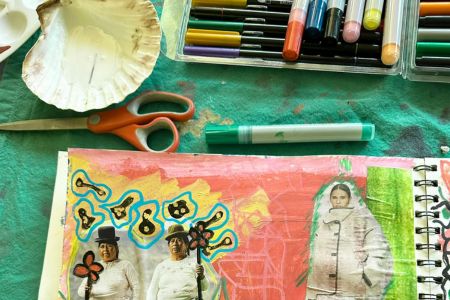
As we sat together, cutting and arranging images, something beautiful unfolded. There was no pressure. No expectation. Just curiosity and play. I watched as she became absorbed in the process, her energy settling as her focus deepened. The collage became a quiet conversation, not one that needed words, but one that spoke volumes.
That session stayed with me. It inspired me to develop collage as an ongoing creative tool for my clients. Something they can return to again and again as a way to ground themselves, express emotions safely, and find moments of clarity in the midst of inner noise.
Collage as a Form of Art and Healing
Collage is a powerful and accessible art form. At its core, collage involves assembling different materials (photographs, paper, textures, words…) to create a new whole. What makes collage so effective, especially in therapeutic or reflective settings, is that it removes the pressure to “draw well” or “be artistic.”
You don’t need technical skills to make a collage. You only need to respond to what attracts you. This makes it particularly supportive for people who feel disconnected from their creativity or intimidated by traditional art forms.
Collage allows the unconscious mind to speak. The images you choose often reflect inner emotions, desires, or experiences that may be difficult to articulate verbally. By placing them together, you create meaning visually, intuitively, and safely.
A Brief History of Collage
Collage as an art form emerged in the early 20th century, most notably through the work of artists Pablo Picasso and Georges Braque around 1912. They began incorporating everyday materials such as newspaper clippings, wallpaper, and fabric into their paintings, challenging traditional ideas of what art could be.
This approach was revolutionary. Instead of creating images solely through drawing or painting, artists began assembling fragments of the real world to express new perspectives. Collage became closely associated with modern art movements such as Cubism, Dadaism, and Surrealism, all of which explored fragmentation, symbolism, and the subconscious.
Later, collage found its way into therapeutic practices. Psychologists and art therapists recognised its potential as a tool for self-expression, particularly for those who struggled to communicate feelings through words alone. Today, collage is widely used in creative therapy, education, and personal development, as a way to explore identity, emotions, and inner landscapes.
Why Collage Is So Effective as a Tool
One of the greatest strengths of collage is its gentleness. It meets people where they are. Because you are working with pre-existing images, the process feels supportive rather than demanding. You are not creating from nothing; you are selecting, responding, and rearranging.
This mirrors how healing often works. We take fragments of experience, memory, and emotion, and slowly make sense of them in a way that feels safe. Collage offers a visual language for this process.
It also encourages curiosity instead of judgment. There is no right or wrong way to make a collage. This freedom allows the nervous system to relax, opening the door to clarity and insight. Often, people find that once the collage is complete, they understand something about themselves that they couldn’t access before.
Creativity as Ongoing Care
Creativity is not just an activity; it is a form of care. When used intentionally, creative tools like collage become anchors, moments of stillness in a busy world. They remind us that peace doesn’t always come from solving problems, but from allowing ourselves to pause and create.
That session with my client reinforced something I deeply believe: when young people (and also adults) are given space to create without pressure, something inside them settles. They feel seen, even by themselves. And in that space, clarity naturally arises.
Creativity clears the head because it invites us out of thinking and into being. It creates peace by bringing us home to the present moment. And sometimes, all it takes is a pair of scissors, a few images, and the courage to begin.
February 9, 2026

